Food

Share Food on Facebook Share Food on Twitter Share Food on Linkedin Email Food link

Why food matters in Powys

Food sits at the heart of Powys’ identity, economy and landscape — and at the centre of its climate challenge.

As a predominantly rural county, Powys’ communities and livelihoods are closely tied to farming and land use. Climate change is already affecting food systems through:

  • Wetter winters and hotter, drier summers
  • Increased flooding and drought
  • Pressure on grass growth and livestock health
  • Supply chain disruption
  • Rising input costs

These changes affect food production, rural incomes and local resilience.

Food represents the single largest area of emissions in Powys at almost 50% (48.89%) of Powys’ total carbon footprint. This includes emissions linked to agriculture, land use and food consumption.

Emissions from land use, land-use change and agriculture make up 28% of Powys’ total footprint, amounting to around 1.0 million tonnes CO₂e - largely driven by livestock agriculture, reflecting the county’s rural landscape and farming profile. This reflects Powys’ rural economy and farming heritage.

Food accounts for 27% of a resident’s footprint (third highest contributor) and 6% of a visitor’s footprint.

But it also represents one of the greatest opportunities for transformation.

By aligning climate action with Powys’ rural context, the county can:

  • Strengthen local food security
  • Support farmers to adapt and diversify
  • Improve public health outcomes
  • Restore soils, habitats, water systems and reduce flooding
  • Build long-term economic resilience

Together with nature recovery, food system change can transform Powys’ land into a cornerstone of climate action.

Food as a climate and well-being solution

Powys has a unique opportunity. With the right approach, transforming food and land systems can strengthen food security, improve public health and support a thriving rural economy.

Food system change can improve public health, support farmers, reduce waste and strengthen local supply chains — building pride and resilience across Powys.

Food and nature recovery are deeply interconnected — and central to climate action in Powys.

Shaping Powys’ future

Food system change must strengthen rural livelihoods as well as reduce emissions. In Powys, progress depends on partnership between farmers, businesses, public services and communities — so change supports both health and economic resilience.

Scaling up the food system transformation in Powys will involve:

  • Supporting farmers to adapt, diversify and reduce emissions
  • Promoting healthy, affordable local food across communities
  • Reducing food waste across households, businesses and public services
  • Strengthening local processing and supply chains
  • Managing land for multiple benefits: food, nature, water and carbon
  • Supporting farmers to adapt, diversify and reduce high-carbon farm inputs and emissions

Public bodies in Powys support food system transition through land use planning, public procurement, rural development programmes and partnership working that strengthen local supply chains, improve food security and promote sustainable land management

The goal is to make low-carbon and resilient food options the tasty easy, affordable choice — backed by investment and services.


Across Powys, people and organisations are already taking action — these examples show what’s happening now.
Case Study

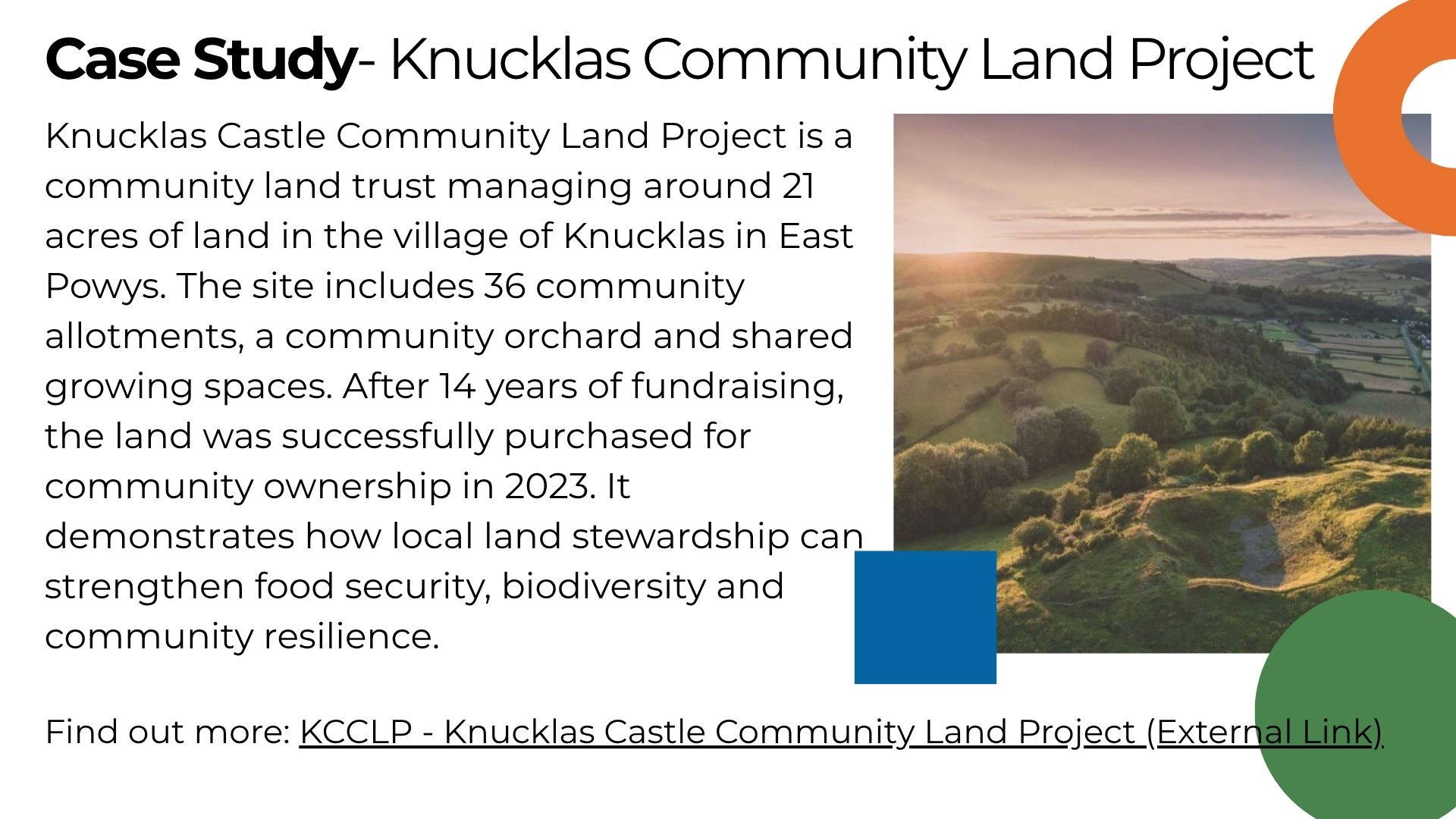
Knucklas Castle Community Land Project is a community land trust managing around 21 acres of land in the village of Knucklas in East Powys. The site includes 36 community allotments, a community orchard
and shared growing spaces. After 14 years of fundraising, the land was successfully purchased for community ownership in 2023. It demonstrates how local land stewardship can strengthen food security, biodiversity and community resilience.

Find out more: KCCLP - Knucklas Castle Community Land Project (External Link)


Case Study

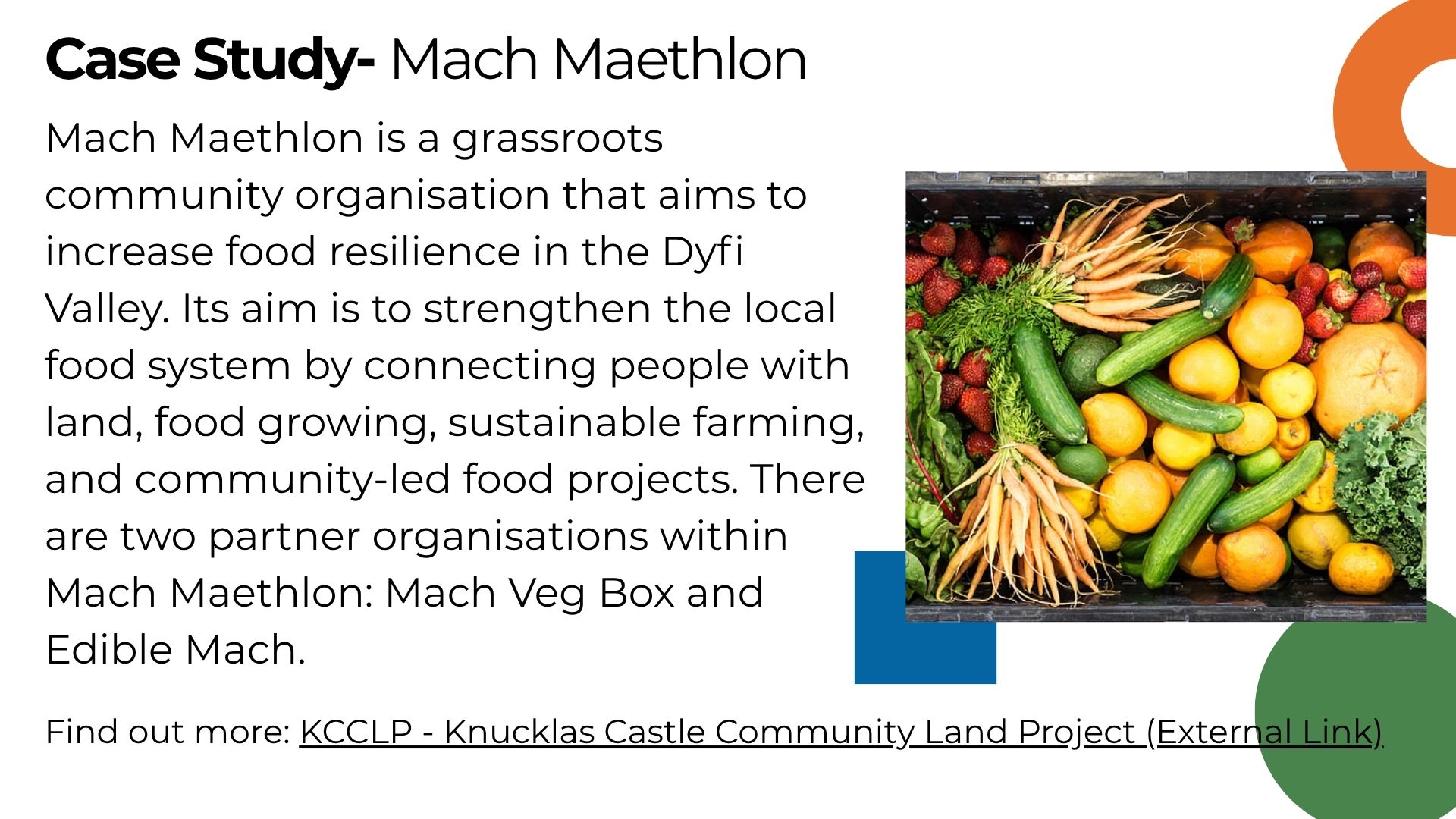
Mach Maethlon is a grassroots community organisation that aims to increase food resilience in the Dyfi Valley. There are two partner organisations within Mach Maethlon: Mach Veg Box and Edible Mach.

Find out more: Mach Maethlon © 2024 – hoi bwyd yng nghalon y gymuned (External Link)


Unlocking food action across Powys

Alongside public sector delivery, these partners help communities and businesses take action.

Bwyd Powys Food Partnership

Bwyd Powys Food works to support good, local, sustainable food across the county.

The partnership promotes:

  • Sustainable food production
  • Healthy diets
  • Stronger local supply chains
  • Community engagement through its Food Charter

The Food Charter(External link) promotes sustainable food practices across the county and encourages people to pledge an action and become active food citizens.

The Bwyd Powys Food map is an easy-access tool to find out about sustainable food near you.

Find out more here: The Powys Food Map - Bwyd Powys Food (External Link)

Evidence-led action

Evidence is helping public services, businesses and communities focus effort where it will make the most difference.

Powys’ carbon footprint

You can explore the full detail of Powys’ carbon footprint, including in relation to food, in the Powys County: Carbon Baseline and Climate Transition by Small World Consulting.

Small World Consulting Report

Young people imagining the future of food report

You can also read the Future Food – Re-centring Stakeholder Involvement for Policy Development report, which explores how engagement — particularly with young people — can shape more sustainable food futures.

Future Food Feasibility

Dyfed-Powys Food Civil Resilience report

Dyfed Powys Civil Food Resilience - Pembrokeshire Local Food Partnership (External Link)

Why food matters in Powys

Food sits at the heart of Powys’ identity, economy and landscape — and at the centre of its climate challenge.

As a predominantly rural county, Powys’ communities and livelihoods are closely tied to farming and land use. Climate change is already affecting food systems through:

  • Wetter winters and hotter, drier summers
  • Increased flooding and drought
  • Pressure on grass growth and livestock health
  • Supply chain disruption
  • Rising input costs

These changes affect food production, rural incomes and local resilience.

Food represents the single largest area of emissions in Powys at almost 50% (48.89%) of Powys’ total carbon footprint. This includes emissions linked to agriculture, land use and food consumption.

Emissions from land use, land-use change and agriculture make up 28% of Powys’ total footprint, amounting to around 1.0 million tonnes CO₂e - largely driven by livestock agriculture, reflecting the county’s rural landscape and farming profile. This reflects Powys’ rural economy and farming heritage.

Food accounts for 27% of a resident’s footprint (third highest contributor) and 6% of a visitor’s footprint.

But it also represents one of the greatest opportunities for transformation.

By aligning climate action with Powys’ rural context, the county can:

  • Strengthen local food security
  • Support farmers to adapt and diversify
  • Improve public health outcomes
  • Restore soils, habitats, water systems and reduce flooding
  • Build long-term economic resilience

Together with nature recovery, food system change can transform Powys’ land into a cornerstone of climate action.

Food as a climate and well-being solution

Powys has a unique opportunity. With the right approach, transforming food and land systems can strengthen food security, improve public health and support a thriving rural economy.

Food system change can improve public health, support farmers, reduce waste and strengthen local supply chains — building pride and resilience across Powys.

Food and nature recovery are deeply interconnected — and central to climate action in Powys.

Shaping Powys’ future

Food system change must strengthen rural livelihoods as well as reduce emissions. In Powys, progress depends on partnership between farmers, businesses, public services and communities — so change supports both health and economic resilience.

Scaling up the food system transformation in Powys will involve:

  • Supporting farmers to adapt, diversify and reduce emissions
  • Promoting healthy, affordable local food across communities
  • Reducing food waste across households, businesses and public services
  • Strengthening local processing and supply chains
  • Managing land for multiple benefits: food, nature, water and carbon
  • Supporting farmers to adapt, diversify and reduce high-carbon farm inputs and emissions

Public bodies in Powys support food system transition through land use planning, public procurement, rural development programmes and partnership working that strengthen local supply chains, improve food security and promote sustainable land management

The goal is to make low-carbon and resilient food options the tasty easy, affordable choice — backed by investment and services.


Across Powys, people and organisations are already taking action — these examples show what’s happening now.

Case Study

Knucklas Castle Community Land Project is a community land trust managing around 21 acres of land in the village of Knucklas in East Powys. The site includes 36 community allotments, a community orchard
and shared growing spaces. After 14 years of fundraising, the land was successfully purchased for community ownership in 2023. It demonstrates how local land stewardship can strengthen food security, biodiversity and community resilience.

Find out more: KCCLP - Knucklas Castle Community Land Project (External Link)


Case Study

Mach Maethlon is a grassroots community organisation that aims to increase food resilience in the Dyfi Valley. There are two partner organisations within Mach Maethlon: Mach Veg Box and Edible Mach.

Find out more: Mach Maethlon © 2024 – hoi bwyd yng nghalon y gymuned (External Link)


Unlocking food action across Powys

Alongside public sector delivery, these partners help communities and businesses take action.

Bwyd Powys Food Partnership

Bwyd Powys Food works to support good, local, sustainable food across the county.

The partnership promotes:

  • Sustainable food production
  • Healthy diets
  • Stronger local supply chains
  • Community engagement through its Food Charter

The Food Charter(External link) promotes sustainable food practices across the county and encourages people to pledge an action and become active food citizens.

The Bwyd Powys Food map is an easy-access tool to find out about sustainable food near you.

Find out more here: The Powys Food Map - Bwyd Powys Food (External Link)

Evidence-led action

Evidence is helping public services, businesses and communities focus effort where it will make the most difference.

Powys’ carbon footprint

You can explore the full detail of Powys’ carbon footprint, including in relation to food, in the Powys County: Carbon Baseline and Climate Transition by Small World Consulting.

Small World Consulting Report

Young people imagining the future of food report

You can also read the Future Food – Re-centring Stakeholder Involvement for Policy Development report, which explores how engagement — particularly with young people — can shape more sustainable food futures.

Future Food Feasibility

Dyfed-Powys Food Civil Resilience report

Dyfed Powys Civil Food Resilience - Pembrokeshire Local Food Partnership (External Link)

Page published: 27 Mar 2026, 04:27 PM