Economy

Share Economy on Facebook Share Economy on Twitter Share Economy on Linkedin Email Economy link

Why the economy matters in Powys

Powys’ economy is shaped by its rural character. As the climate changes, extreme weather, supply chain disruption and rising energy costs are increasing risks for local livelihoods. Agriculture, tourism and small and medium-sized enterprises are central to employment and depend on reliable transport links, healthy natural systems and services that can operate consistently throughout the year.

At the same time, the transition to a low-carbon, resource-efficient economy can strengthen resilience, reduce emissions and keep more value within Powys.
The economy as a climate and well-being solution

Emissions linked to goods, services and resource use account for around 27% of Powys’ total carbon footprint and are the largest share of the average resident footprint (33%). These emissions reflect the carbon impact of everyday goods and services — from household purchases to public services, construction and waste.

In Powys, these impacts are influenced by structural, place-based factors including transport access, heating demand, rural service provision and the availability of local goods and services. Reducing emissions in this area is therefore closely linked to improving affordability, access and local resilience.

Shaping Powys’ future

A resource-efficient economy reduces waste, keeps materials in use for longer and supports local livelihoods. In Powys, progress will focus on:

  • Expanding reuse, repair and sharing models across towns and villages
  • Supporting businesses to improve resource efficiency and reduce waste
  • Growing green skills and local employment opportunities
  • Strengthening local supply chains to keep value within Powys
  • Making lower-carbon options affordable and accessible

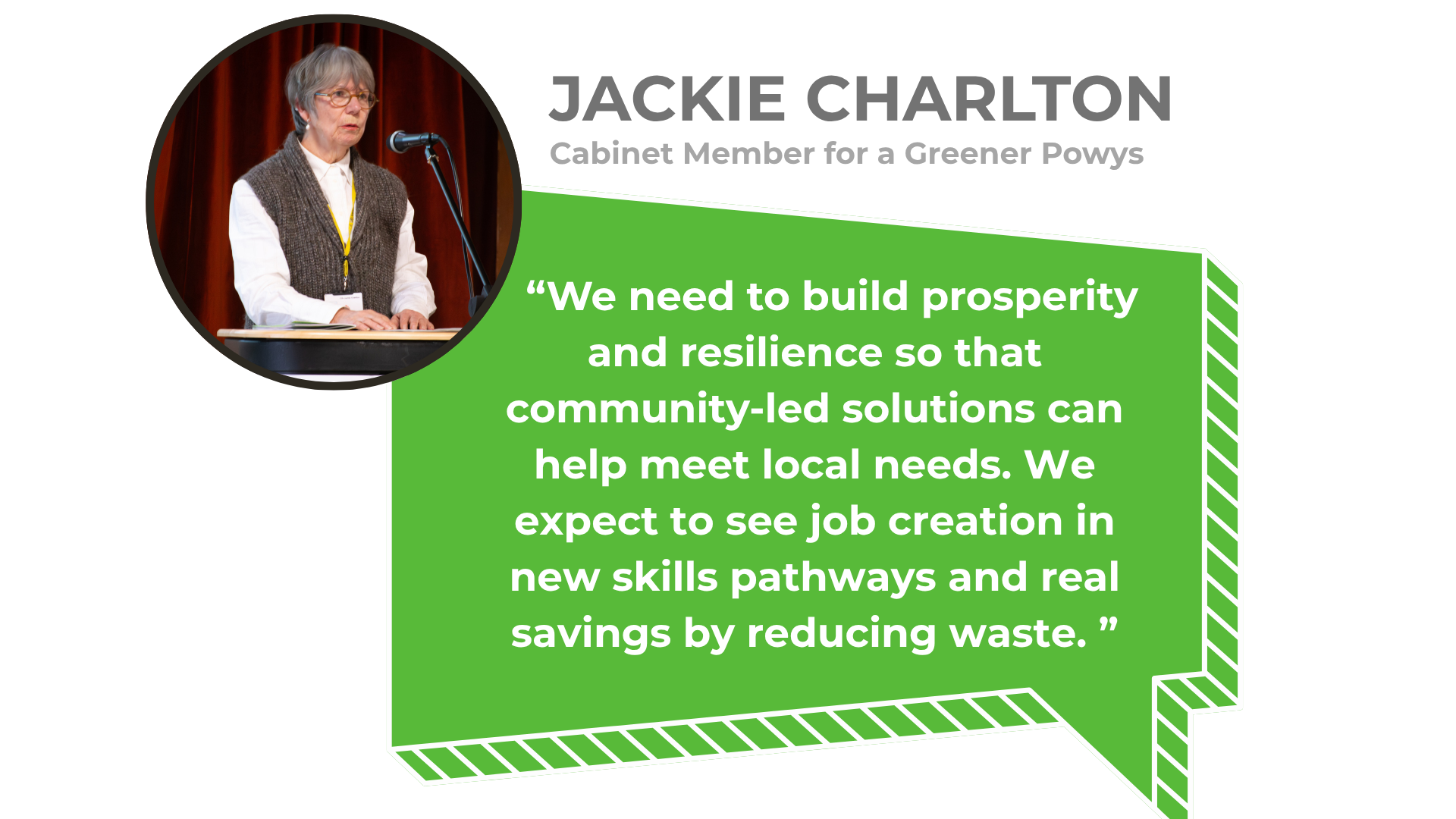
Public bodies in Powys support economic transition by using their roles in procurement, estates, waste services and local economic development to strengthen local supply chains, reduce resource use and support green skills and jobs.

Local action already underway across Powys
Case Study

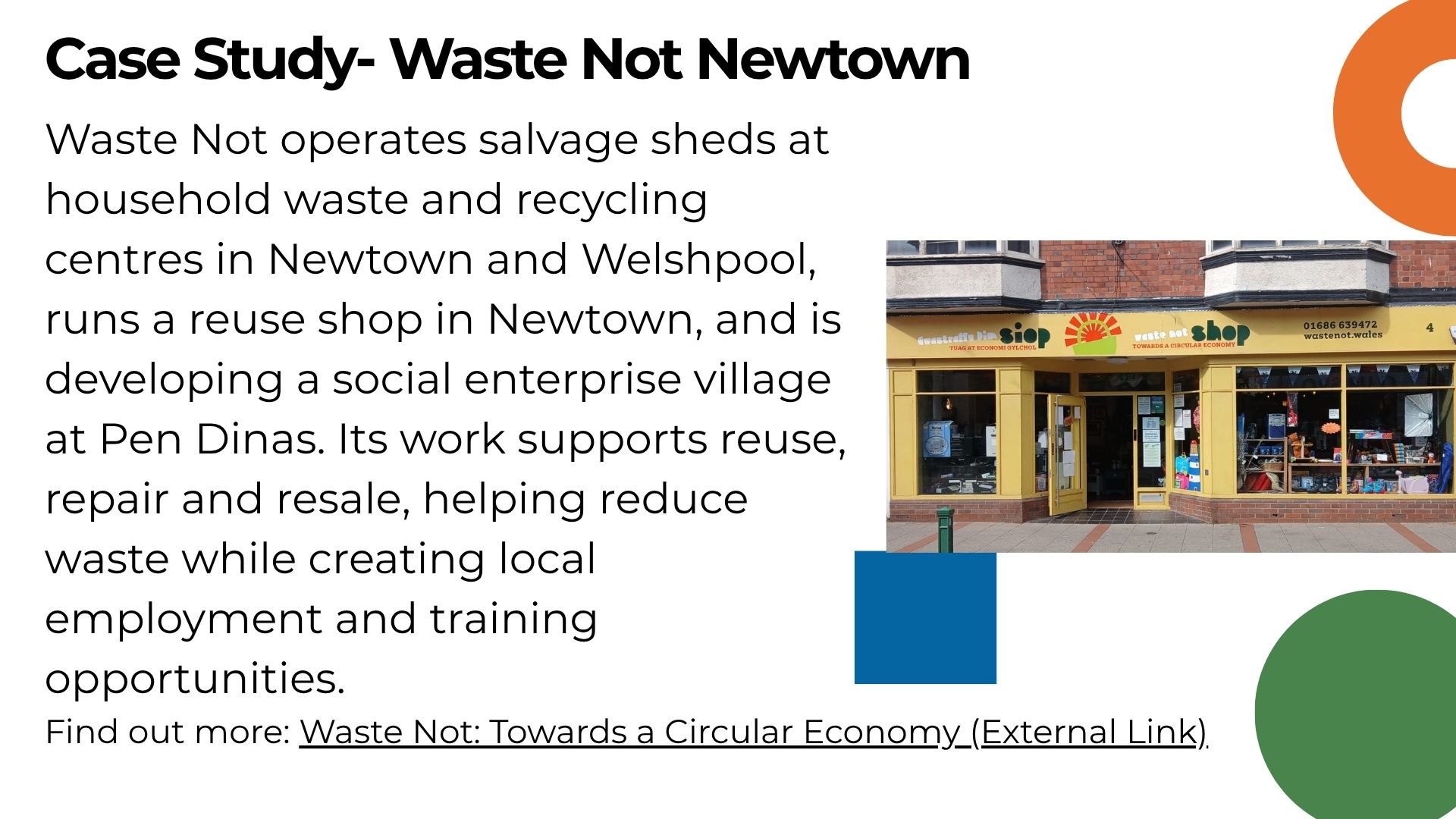
Waste Not operates salvage sheds at household waste and recycling centres in Newtown and Welshpool, runs a reuse shop in Newtown, and is developing a social enterprise village at Pen Dinas. Its work supports reuse, repair and resale, helping reduce waste while creating local employment and training opportunities.

Find out more: Waste Not: Towards a Circular Economy (External Link)


Case Study

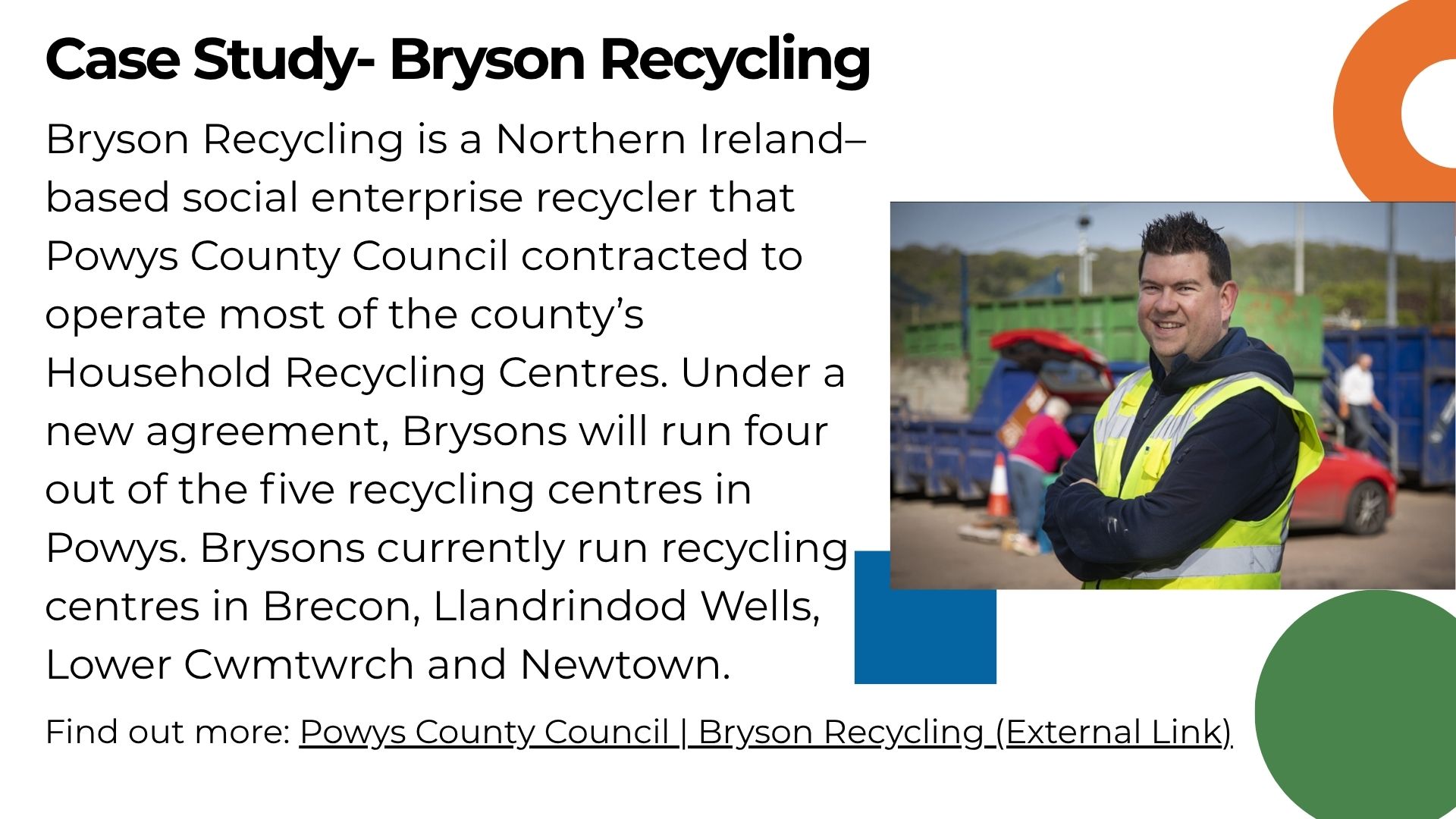
Bryson Recycling is a Northern Ireland–based social enterprise recycler that Powys County Council contracted to operate most of the county’s Household Recycling Centres. Under a new agreement, Brysons will run four out of the five recycling centres in Powys. Brysons currently run recycling centres in Brecon, Llandrindod Wells, Lower Cwmtwrch and Newtown.

Find out more: Powys County Council | Bryson Recycling (External Link)


Case Study

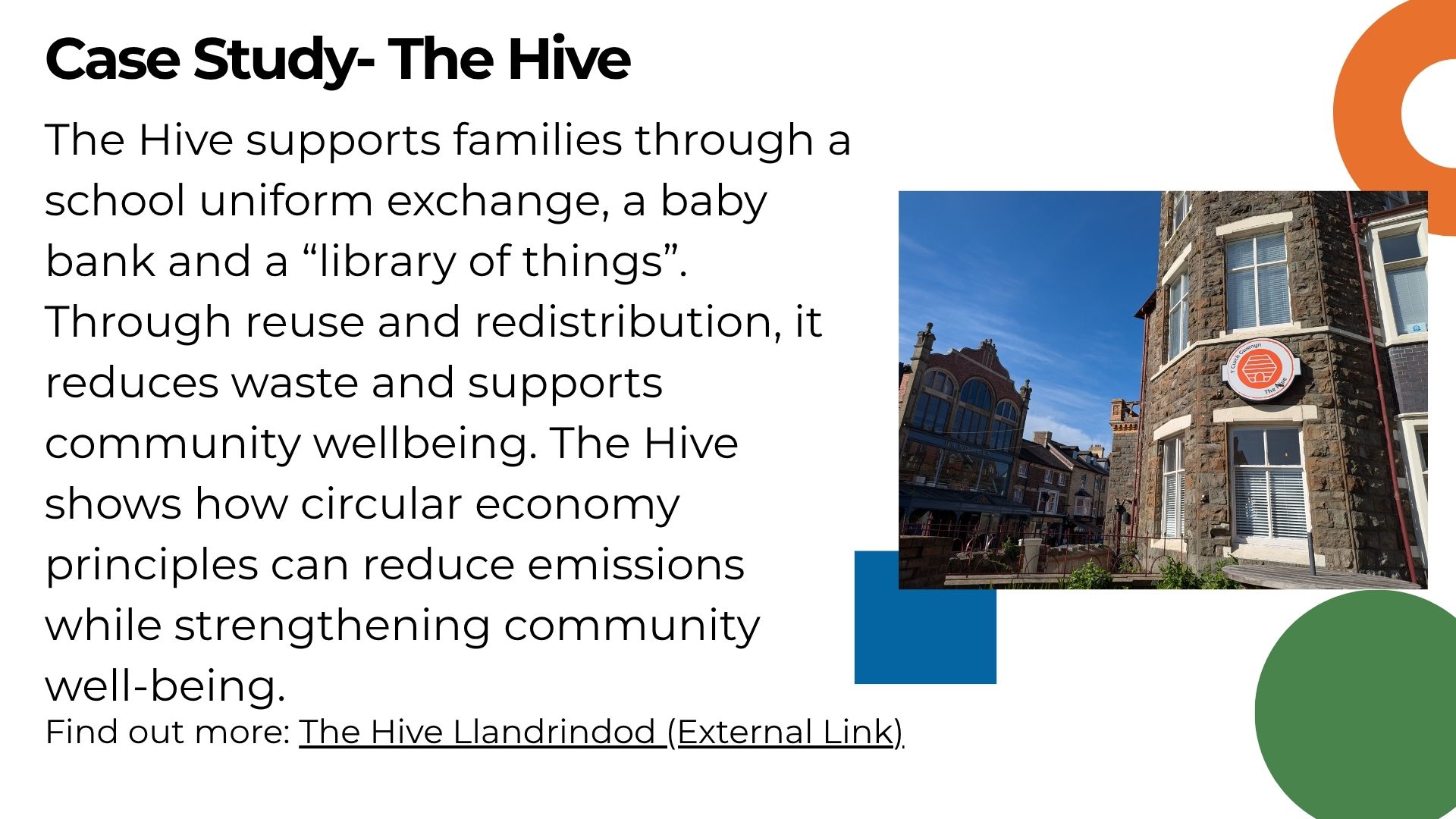
The Hive supports families through a school uniform exchange, a baby bank and a “library of things”. Through reuse and redistribution, it reduces waste and supports community wellbeing. The Hive shows how circular economy principles can reduce emissions while strengthening community well-being.

Find out more: The Hive Llandrindod (External Link)


Unlocking economic action across Powys

These organisations support the transition to a sustainable economy in Powys.

Circular Economy Mid Wales
Supporting reuse, repair and social enterprise development.
Get involved: Waste Not: Towards a Circular Economy (External Link)

Evidence-led action

Evidence is helping public services, businesses and communities focus effort where it will make the most difference.

Powys’ carbon footprint

You can explore the full detail of Powys’ carbon footprint, including in relation to the economy, in the Powys County: Carbon Baseline and Climate Transition by Small World Consulting.

Small World Consulting Report

Why the economy matters in Powys

Powys’ economy is shaped by its rural character. As the climate changes, extreme weather, supply chain disruption and rising energy costs are increasing risks for local livelihoods. Agriculture, tourism and small and medium-sized enterprises are central to employment and depend on reliable transport links, healthy natural systems and services that can operate consistently throughout the year.

At the same time, the transition to a low-carbon, resource-efficient economy can strengthen resilience, reduce emissions and keep more value within Powys.

The economy as a climate and well-being solution

Emissions linked to goods, services and resource use account for around 27% of Powys’ total carbon footprint and are the largest share of the average resident footprint (33%). These emissions reflect the carbon impact of everyday goods and services — from household purchases to public services, construction and waste.

In Powys, these impacts are influenced by structural, place-based factors including transport access, heating demand, rural service provision and the availability of local goods and services. Reducing emissions in this area is therefore closely linked to improving affordability, access and local resilience.

Shaping Powys’ future

A resource-efficient economy reduces waste, keeps materials in use for longer and supports local livelihoods. In Powys, progress will focus on:

  • Expanding reuse, repair and sharing models across towns and villages
  • Supporting businesses to improve resource efficiency and reduce waste
  • Growing green skills and local employment opportunities
  • Strengthening local supply chains to keep value within Powys
  • Making lower-carbon options affordable and accessible

Public bodies in Powys support economic transition by using their roles in procurement, estates, waste services and local economic development to strengthen local supply chains, reduce resource use and support green skills and jobs.

Local action already underway across Powys
Case Study

Waste Not operates salvage sheds at household waste and recycling centres in Newtown and Welshpool, runs a reuse shop in Newtown, and is developing a social enterprise village at Pen Dinas. Its work supports reuse, repair and resale, helping reduce waste while creating local employment and training opportunities.

Find out more: Waste Not: Towards a Circular Economy (External Link)


Case Study

Bryson Recycling is a Northern Ireland–based social enterprise recycler that Powys County Council contracted to operate most of the county’s Household Recycling Centres. Under a new agreement, Brysons will run four out of the five recycling centres in Powys. Brysons currently run recycling centres in Brecon, Llandrindod Wells, Lower Cwmtwrch and Newtown.

Find out more: Powys County Council | Bryson Recycling (External Link)


Case Study

The Hive supports families through a school uniform exchange, a baby bank and a “library of things”. Through reuse and redistribution, it reduces waste and supports community wellbeing. The Hive shows how circular economy principles can reduce emissions while strengthening community well-being.

Find out more: The Hive Llandrindod (External Link)


Unlocking economic action across Powys

These organisations support the transition to a sustainable economy in Powys.

Circular Economy Mid Wales
Supporting reuse, repair and social enterprise development.
Get involved: Waste Not: Towards a Circular Economy (External Link)

Evidence-led action

Evidence is helping public services, businesses and communities focus effort where it will make the most difference.

Powys’ carbon footprint

You can explore the full detail of Powys’ carbon footprint, including in relation to the economy, in the Powys County: Carbon Baseline and Climate Transition by Small World Consulting.

Small World Consulting Report

Page published: 27 Mar 2026, 04:28 PM